
We just shipped AI Usage Explorer. Here’s why.



Most enterprises now report AI adoption in three ways: seats purchased, tokens consumed, and monthly active users. These numbers are fine for a slide. They do not tell you whether the investment is working, which teams are actually using AI, or what they are doing with it.
That gap is the problem and it is honestly larger than most leaders realize.
Tokens measure consumption, not value
Token spend has become the de facto ROI signal for enterprise AI budgets. The logic is appealing: more tokens means more usage, more usage means more value. But a 2-minute ChatGPT query to rephrase a subject line may consume tokens just like a 12-minute Claude Cowork session working through a contract analysis. The number aggregates everything into one figure, which makes it almost useless as a signal for whether your AI investment is producing business outcomes.
Seats are equally misleading. You can provision 5,000 Copilot licences and discover, as many of our customers have, that a significant portion of your Go to Market team's AI activity is happening on personal ChatGPT accounts anyway. The seat count looks healthy. The actual picture is a coverage gap, with sales reps doing competitive research and drafting proposals on tools the security team cannot see.
Tokenmaxxing — the instinct to treat raw consumption as proof of value — is the wrong game entirely. Volume without context is noise.
Who is actually using AI, and for what
So what is actually going on?
Last week, we published our analysis of 1.9 million classified AI-session minutes across enterprise customers.
Legal and Governance accounts for 19.5% of all enterprise AI hours, more than any other function. For most CISOs and CIOs we speak to, that is a surprise. The assumption is that developers and data teams drive AI adoption. In practice, it is lawyers reviewing contracts, drafting regulatory filings, and running compliance analysis. And they are doing it largely on ChatGPT (67% of Legal AI hours), at the highest volume of any department in the dataset.
Meanwhile, Go to Market teams represent 28.6% of activity on free, personal accounts. Sales and marketing are running ahead of corporate provisioning, using whatever is already open in the browser.
These are patterns that no token dashboard surfaces and, instead, require understanding which tools are being used, by whom, and for what kind of work.
Usage data changes how companies spend
Several of our customers have restructured their AI investment in direct response to usage intelligence. Legal teams got enterprise accounts because volume and risk justified it. Go to Market rollouts accelerated because personal-account activity was already well ahead of corporate provisioning. Teams with deep, iterative session patterns got specialist tooling; lighter users kept general-purpose access.
None of those decisions were possible from a token report.
The broader point is this: AI budgets are now significant line items, and the pressure to show return on them is growing. Token spend tells you what AI costs. Usage intelligence tells you whether it is worth it and, more usefully, where to invest next.
AI Usage Explorer is now in all of our products
That is what we built an AI Usage Explorer to answer. It is available across all our products, and the premise is straightforward: real visibility into AI use, with use cases mapped across both sanctioned and unsanctioned tools, gives you the best possible shot at governing AI effectively without slowing the business down. You cannot make good decisions about what to restrict, what to expand, and where to invest if you are only watching half the picture.
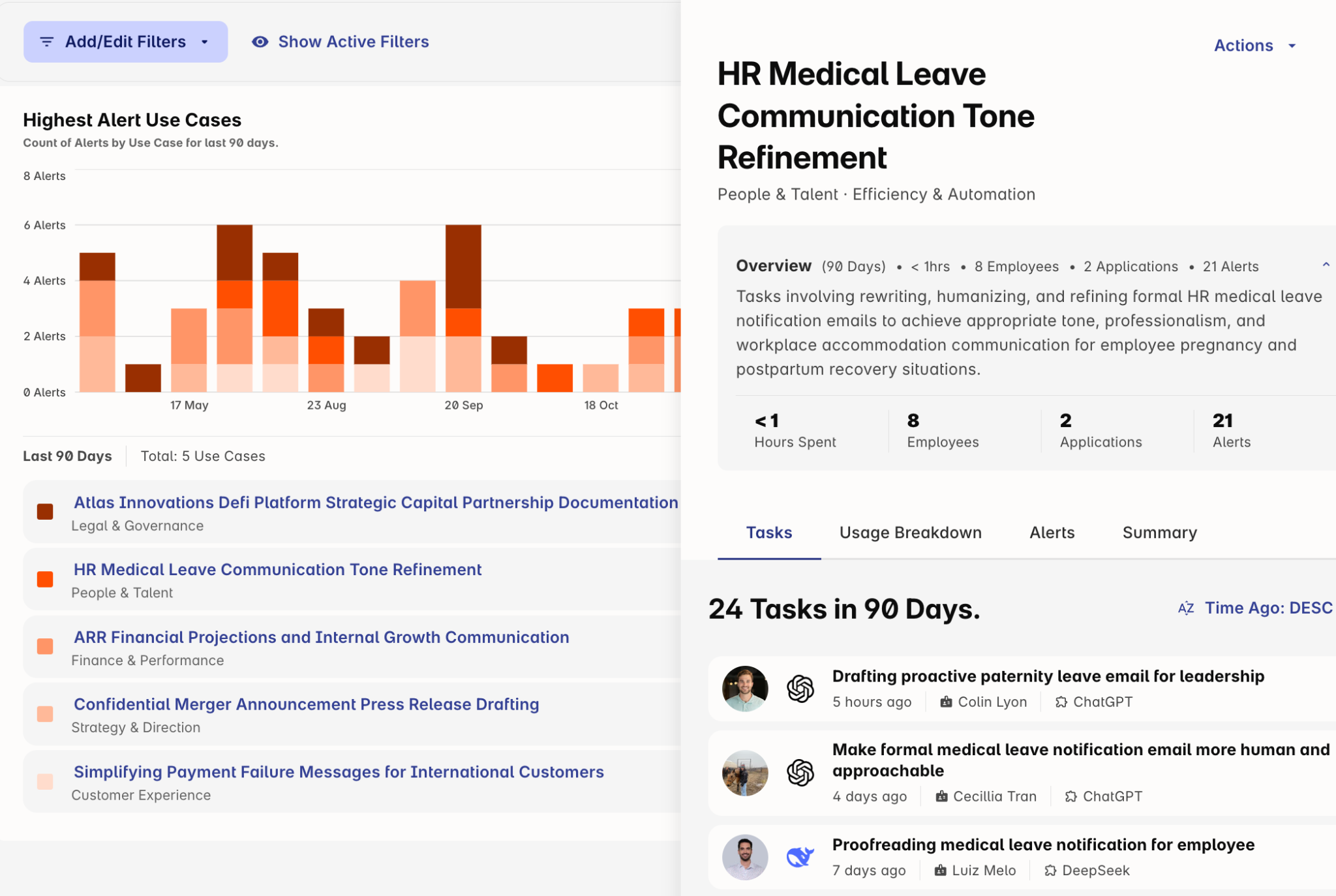
Full deployment takes around 30 minutes. If you want to see what your organization actually looks like, reach out to the team or visit harmonic.security/solutions/ai-usage-intelligence.
.png)
.png)
