How security frameworks apply to employee AI usage



Some people love security frameworks. Many see them as paperwork that gets in the way of real security work. At a minimum, they give us a shared lens for thinking about risk, setting expectations and deciding what good looks like.
But frameworks are not created equal, and they were not all designed to do the same job. Understanding what each is really for makes it easier to effectively apply them and to know where you need to look beyond them for practical AI security controls.
Below, we assess what five of the most popular frameworks contribute in practice and how they compare. We also share examples of how they apply to controls in our workforce AI security requirements guide, which contains full mappings for each framework discussed.
SOC 2 offers limited implementation guidance
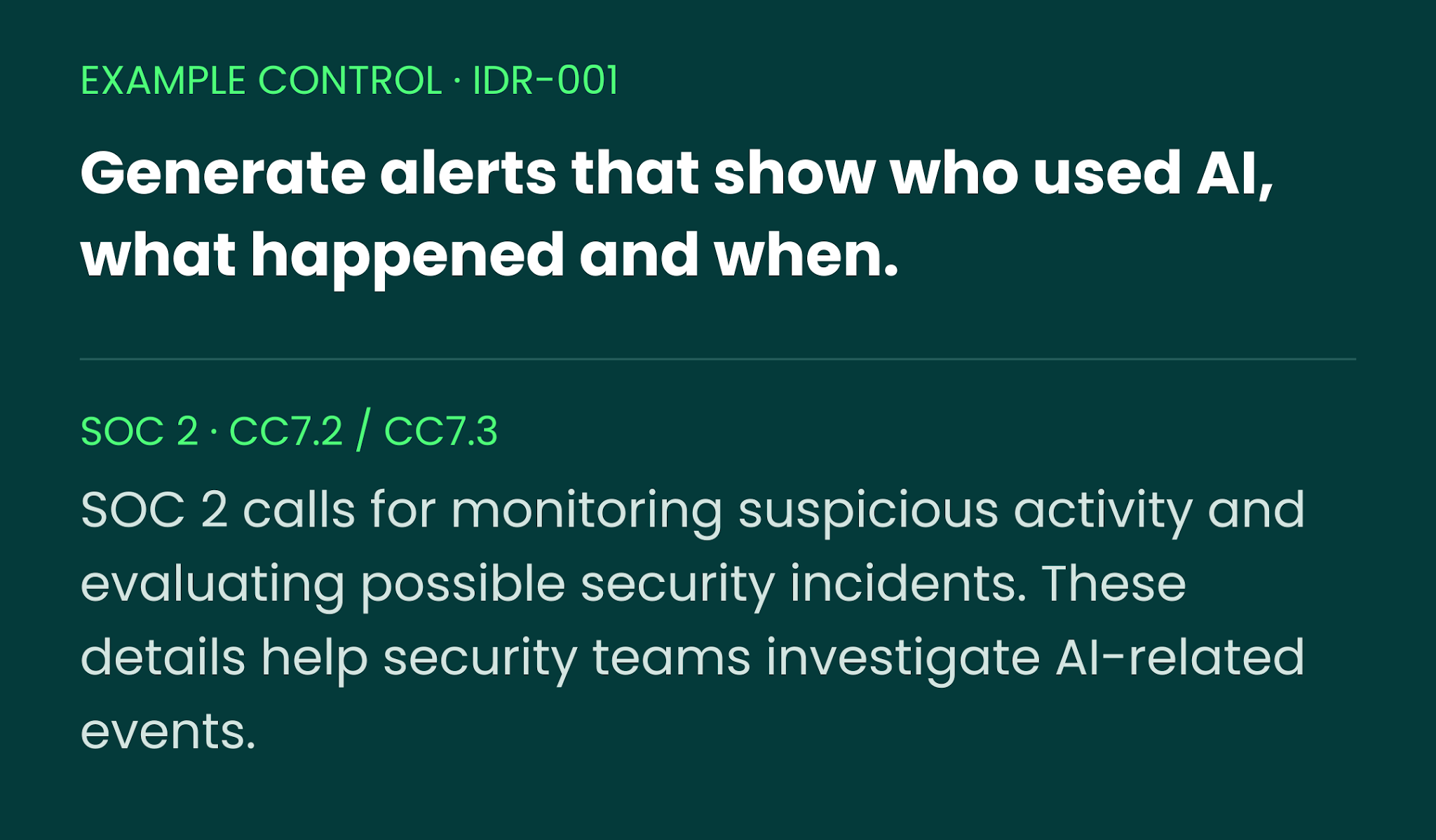
SOC 2 is an assurance examination of an organization's controls against AICPA's Trust Services Criteria, within a defined system scope. A Type II examination evaluates control design and operating effectiveness over a specified period. For security teams, its practical value is the discipline of defining controls for their own in-scope systems, maintaining evidence and demonstrating that those controls operate. It is a weaker starting point for structuring an ongoing employee AI security program.
Where employee AI use could affect the service commitments and system requirements in scope, AICPA's AI guidance calls for the examination to consider it. Evidence can include how relevant use is identified, how risks are assessed and how controls operate. A conclusion that AI is irrelevant to an in-scope system also needs support, including controls for detecting unapproved use.
The organization remains responsible for selecting controls and defining their coverage. SOC 2 does not, for example, specify how to discover personal AI accounts, prevent sensitive uploads or restrict an agent's actions. The report's value lies only in the controls, systems and period actually examined.
ISO 27001 provides a practical info-sec foundation
ISO/IEC 27001 sets requirements for an information-security management system: a repeatable process for identifying risks, choosing controls, reviewing performance and improving protection. For employee AI use, it is the most practical security foundation in this group. The immediate challenges are largely familiar: identifying the services employees use, managing access and preventing unauthorized disclosure of information.
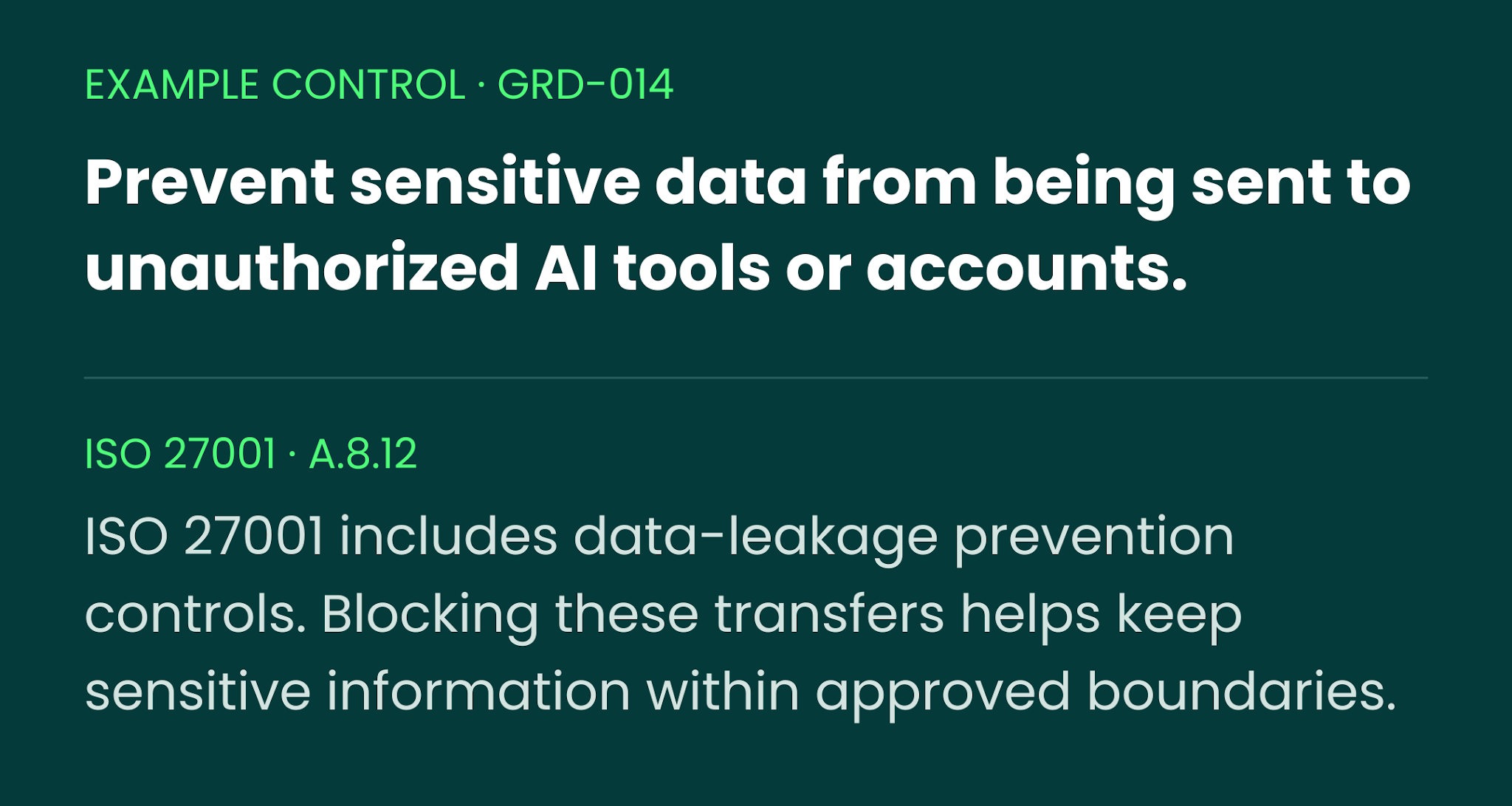
Annex A provides a reference set of controls covering areas such as asset inventory, acceptable use, access, supplier and cloud security, data-leakage prevention, logging and monitoring. The organization selects controls based on its risks. Its Statement of Applicability records the necessary controls and the reasons for inclusion or exclusion. The standard does not require every Annex A control to be deployed identically. An ISO committee-hosted auditing note explains this distinction.
Effectiveness depends on coverage. A policy limited to approved SaaS tools may exclude personal AI accounts, or a data-loss prevention deployment may not inspect uploads to a desktop assistant. Security teams need to apply the relevant controls to the tools, accounts and workflows employees actually use, then test them.
ISO 42001 makes AI decisions accountable
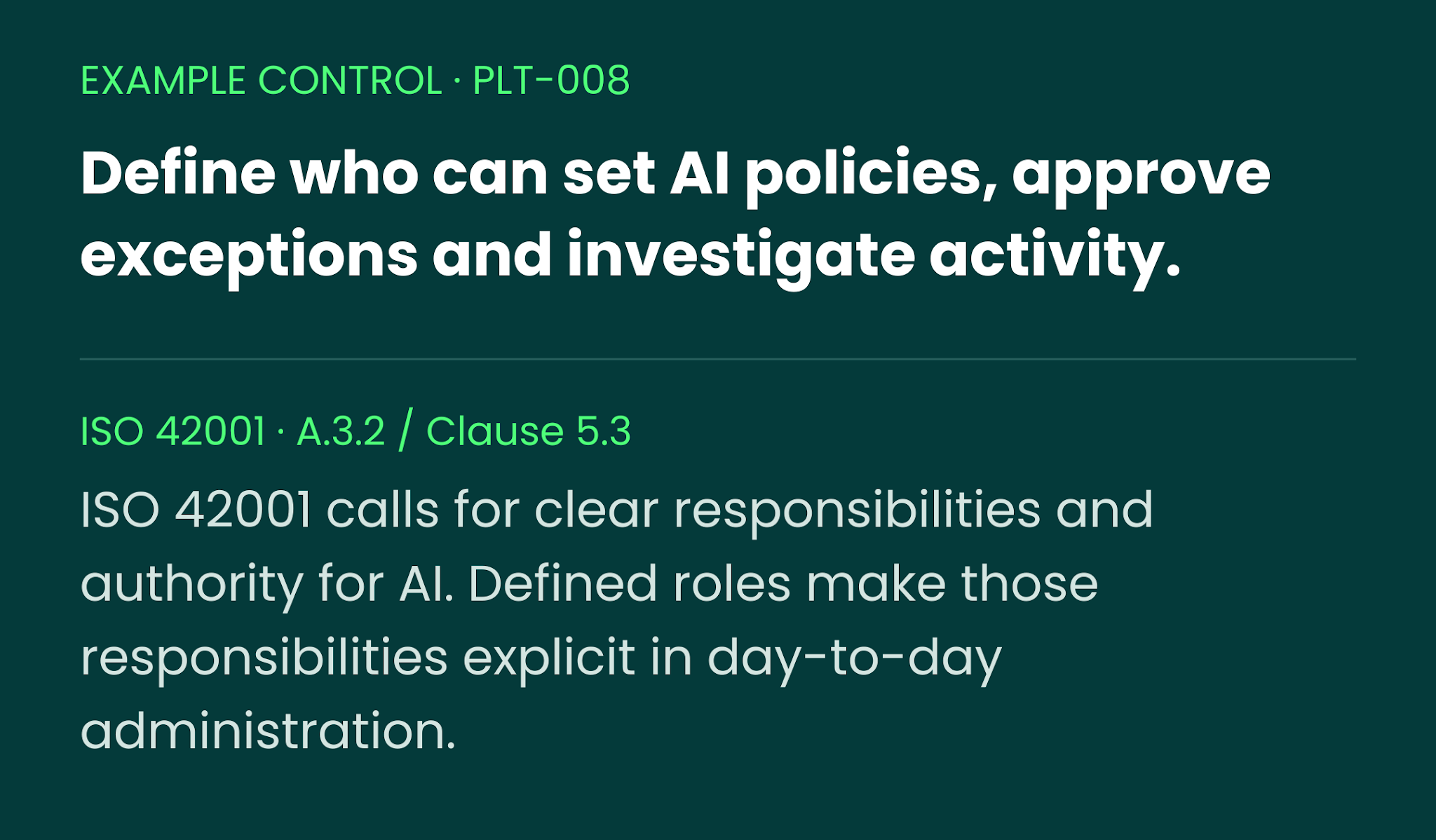
ISO/IEC 42001 sets requirements for an AI management system, covering organizations that use AI as well as those that develop or provide it. Its main contribution for an employer is a structured process for AI decisions: who approves a use case, who assesses its risks and effects on people, and who revisits that assessment when the use changes. Within the defined scope, this includes documented risk and impact assessments, risk treatment and evidence that the processes operate and that their effectiveness is evaluated.
Annex A covers AI resources, responsible use and supplier responsibilities, as well as verification and validation, operational monitoring and event logging. The relevant controls depend on the organization’s role, scope and risk assessment. For employee AI, an AI-use register linked to assessments, named owners and approved-use rules makes that governance operational. An assistant authorized to update customer records, for example, needs an assessment of the consequences of those changes as well as the data it can access.
The strongest case for ISO 42001 is accountable decision-making, especially where AI use affects people or business processes. It still leaves the organization to specify runtime controls: which sensitive prompts to block, which actions require approval and how those rules are enforced. Its AI-specific focus complements the access and data-protection foundation of ISO 27001; it should not displace it.
NIST helps organize the program and assess specific AI uses
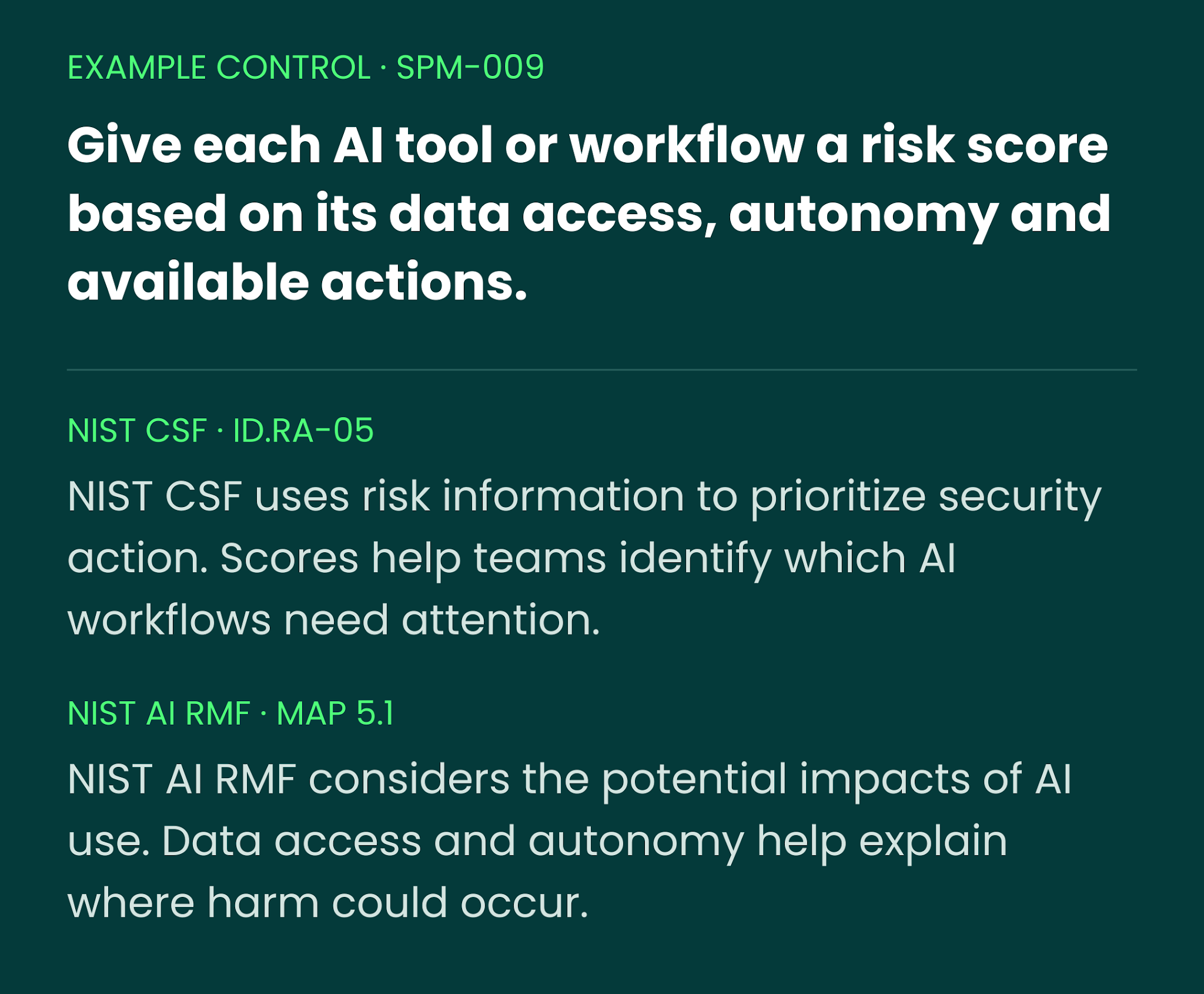
NIST's Cybersecurity Framework 2.0 (CSF) and AI Risk Management Framework (AI RMF) address different levels of the problem. CSF defines cybersecurity outcomes that help incorporate employee AI use into the existing security program. AI RMF supports decisions about the risks of a particular AI use and the conditions under which it is acceptable. Neither is a certification scheme.
CSF 2.0 organizes cybersecurity outcomes into Govern, Identify, Protect, Detect, Respond and Recover. For employee AI, this provides a way to check whether responsibilities and activities form a coherent program, from inventory through incident response. Its outcomes include software and service inventories (ID.AM-02), authorized data flows (ID.AM-03), least-privilege permissions (PR.AA-05) and monitoring technology use (DE.CM-03). CSF's strength is identifying what the program needs to achieve; organizations choose the controls and technology that achieve it.
The AI RMF is better suited to evaluating a specific use case. It brings the purpose of the system, affected people and system behavior into the assessment, rather than treating approval of a tool as approval for every possible use. An assistant drafting internal notes and one making recommendations about employees warrant different assessments, even if they use the same model. Its Generative AI Profile adds suggested actions on acceptable use, providers, third-party access to organizational content and filtering.
This makes AI RMF particularly valuable for challenging blanket approvals. The assessment should establish permitted uses, requirements for human review and conditions for restricting or stopping use. Those decisions then need to be translated into permissions, data-handling rules and tests of system behavior.
OWASP helps test how AI can fail
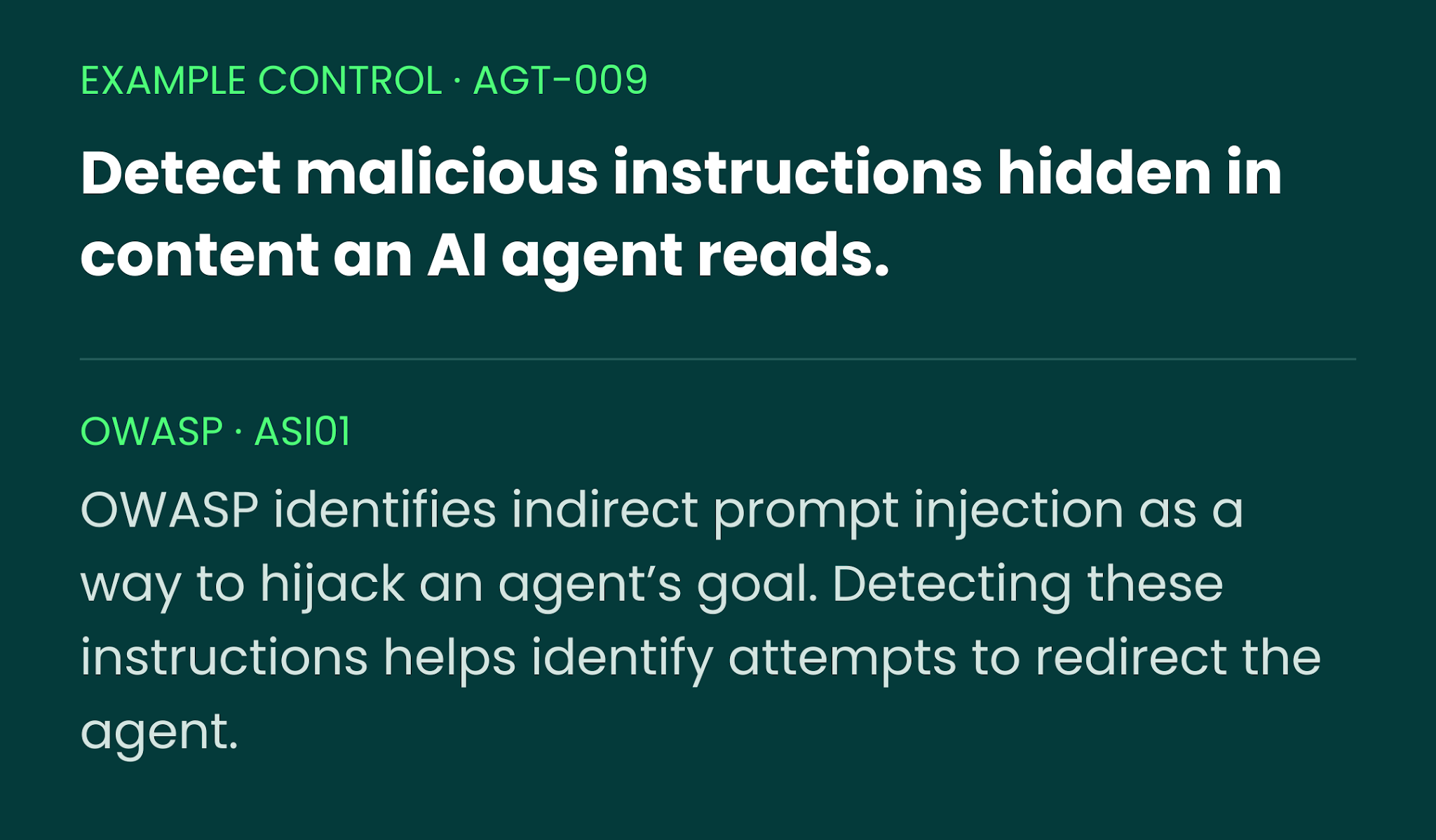
OWASP provides the most concrete guidance in this group on how AI systems can be abused or fail. Its State of Agentic AI Security and Governance v2.01 addresses discovery, inventories, data protection and unmanaged use. The Top 10 for Agentic Applications 2026 names risks including goal hijacking, tool misuse and identity or privilege abuse.
For security teams, these resources provide scenarios for threat modeling and testing controls in their own employee AI programs. Can hostile content redirect the assistant, can it disclose information the user should not see, and can it take actions beyond its intended role? Recommendations such as restricted tool access, policy enforcement before execution, meaningful approvals and action logging help turn those failure scenarios into control requirements.
Some safeguards can be configured or enforced by the security team; others depend on the application provider. Those dependencies should inform the team's own risk assessment, control testing and decisions about permitted use. The distinction between prevention and detection is important: logging an unauthorized action does not stop it, and an approval prompt offers weak protection if the proposed action is unclear. OWASP is strongest as a way to test safeguards against specific failures, alongside organizational decisions about permitted users, data and tasks.
Connecting framework requirements to everyday protection
SOC 2 provides useful expectations for risk assessment, access and monitoring, but its assurance focus offers limited guidance for implementing employee AI guardrails. For organizing that work into an ongoing security program, ISO 27001 is more directly useful, connecting risk assessment and control selection with review and improvement. Alongside that security foundation, ISO 42001 is strongest on AI ownership and oversight, rather than the technical guardrails that make those decisions enforceable.
CSF helps define what that program needs to achieve, offering a clear view of roles and outcomes but less help on specific controls. AI RMF narrows the focus to individual AI uses and is most useful for judging and prioritizing their risks, though those assessments still need to be translated into enforceable controls. OWASP offers the most concrete material here for testing those controls against known failure modes, although it is not a complete model for running a security program.
Our workforce AI security requirements guide connects these perspectives to concrete capabilities and tests, with mappings back to each framework.